CSV Parser
| Block Group: | Table Operations |
| Icon: |  |
The CSV Parser block converts a CSV string into a table.
This is a commonly used block, because many data-driven features in DGLux5, such as charts and repeaters, require tabular data.
The CSV parser block is often used to parse a string that has been retrieved using a String Loader block.
For information on using dataflow blocks, see Dataflow.
For answers to some common questions about working with tables, see Tables.
Video Tutorial: Import CSV File
Input/Output Properties
The following properties of the CSV Parser block can take input and give output.
- input (string)
- withHeader (boolean)
- delimiter (character)
input receives the CSV string. It is often the output from a String Loader block.
withHeader specifies whether the CSV string includes a header row. If TRUE, the first row is used as the column names. If FALSE, the columns are named v1, v2, and so on.
delimiter specifies the character that separates items in the CSV string. Typically this character is a comma (,), which is the default. Only the first character of delimiter is used.
Output Properties
The following properties of the CSV Parser block can give output but cannot take input.
- parseError (boolean)
- output (table)
parseError indicates whether the block encountered an error. An error might be caused by improperly formatted input.
output returns a table parsed from the CSV data.
Example
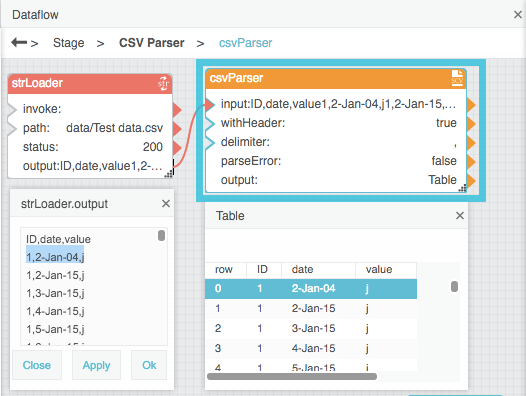
The following image shows, clockwise from top left:
- A String Loader block
- A CSV Parser block
- The output table of the CSV Parser block
- The CSV file